Walt Disney and his company were riding high in 1964. With the release of Mary Poppins to universal acclaim, Walt’s second park, Walt Disney World, under construction in Florida and his Experimental Prototype Community of Tomorrow (EPCOT), Walt’s prototype city of the future, deep into the planning phase, it looked like nothing could stop The Walt Disney Company from changing the world.
However, things would change, but not in the way many expected. On December 15th 1966, Walt Disney would die from lung cancer. This shocked the world as the beloved creator and pioneer of various animated classics and theme park attractions was suddenly gone at the height of his career. With new leadership in the form of Roy Oliver Disney, Walt’s younger brother, coming in to take over The Walt Disney Company, a change in direction in making both live action and animated features for the company would be made. Without their captain, this would usher in what many animation historians would coin as “The Dark Age of Disney” aka “The Disney Dark Age.”
With The Jungle Book (1967) being the final animated film supervised under Walt Disney himself, the current animators and directors would delve into the archives of the past to see what they could find to help them during these unprecedented circumstances. Several of these ideas would later be used to help revitalize the company and would lead to “The Disney Renaissance,” with The Little Mermaid (1989) being the first major hit of the late 1980’s.
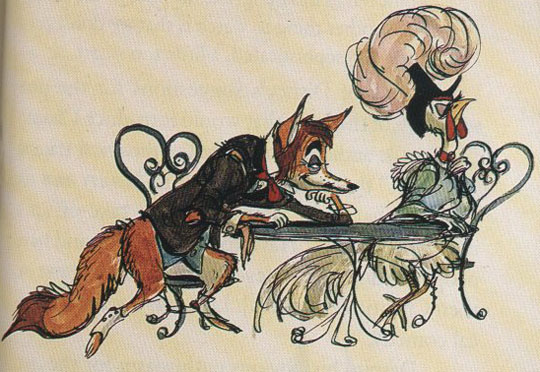
But our focus is on a particular idea that originated as far back as 1937, during the development of Snow White and the Seven Dwarfs. Originally, Walt Disney had plans to adapt the tale of Renyard the Fox, as he was looking at various 12th century European tales to adapt and animate into feature films. However, due to the nature of the character and its source, specifically him being a theft, his amoral nature, being prone to act violently to further his goals and the high level of sophistication needed to understand the actions of such a character, (as the Renyard tale was a political satire criticizing the ruling feudal system in Medieval England), Disney felt that Reynard would not be an appropriate hero for his audience, thus plans for a Reynard film would be shelved. This same idea would later be revisited as part of Treasure Island (1950), as three animated segments were initially planned, with the Reynard story once again being considered for one of them. But all three animated segments would later be dropped. And a third and final attempt to bring Reynard to the silver screen came in the form of a proposed animated musical based on Edmond Rostand’s play of Chanticleer during the 1950’s. The character Chanticleer originated from The Nun’s Priest’s Tale, which was one of several stories in Geoffrey Chaucer’s collected work of The Canterbury Tales. This time Reynard would be made into the villain, but the production was stopped, as Walt Disney was not satisfied with this idea either. He would site everything from the main hero of Chanticleer not being warm and likable enough of a character to once again pointing out that the political satire of the story and the amoral character of Reynard and other characters would not suit Disney’s target audience. This would instead lead to adapting the Arthurian legend of The Sword in the Stone (1963).
Time would pass and now at a critical juncture, the Walt Disney Animation Studio needed an animated feature film that was on budget, had a veteran cast that would please their audience, was overall “safe” and could give them the box office win that they needed to keep going.
On a fateful fishing trip in 1968, Card Walker, the current top studio executive of Walt Disney Productions, suggested to Ken Anderson, the director of story and character concepts at the time, to return to telling a more “classic” story after their current film, The Aristocats, was finishing up its production schedule. Anderson suggested the English tale of Robin Hood to him, which was already popular in the American consciousness thanks to The Adventures of Robin Hood (1938). Walker praised the idea highly and gave his full support to Anderson to see it through. From there, Anderson proposed the concept during a story meeting with the animation team and the project moved forward.
Originally, Anderson wanted to do a contemporary version of the story set in the Deep South, reminiscent of the Walt Disney film that he had fond memories of working on as the Cartoon Art Director in his earlier days with the company: Song of The South. But he proposed updates to keep it in line with the current decade. However, the Disney executive board were wary of this idea, as Song of The South’s reputation had become controversial over time. But it was Wolfgang Reitherman, one of the head Disney animators and one of Walt Disney’s original “Nine Old Men,” strongly insisting to keep the setting in Medieval England, drawing direct inspiration from another Disney film: The Story of Robin Hood (1952). This in turn would avoid any potential controversy and still be true to the original story’s setting.
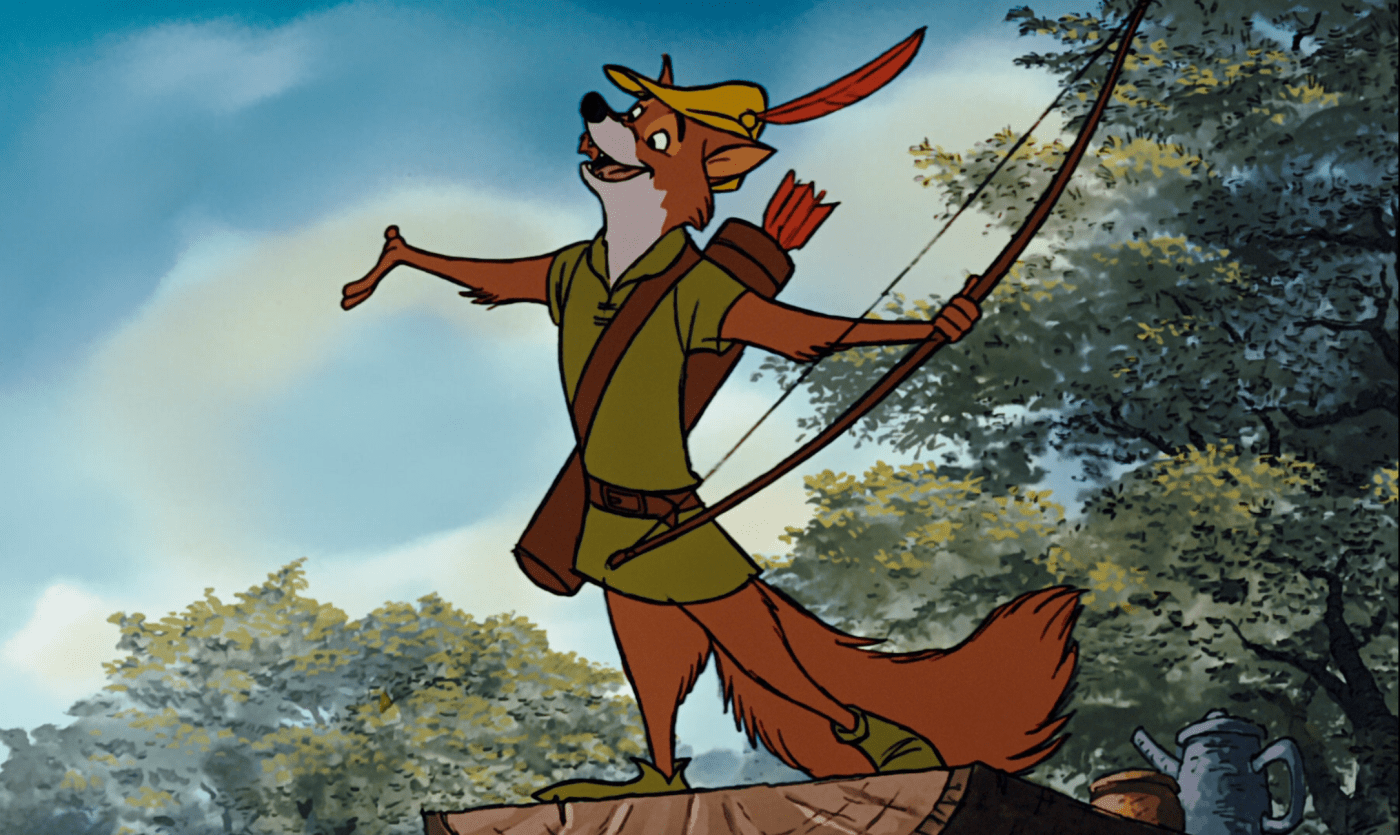
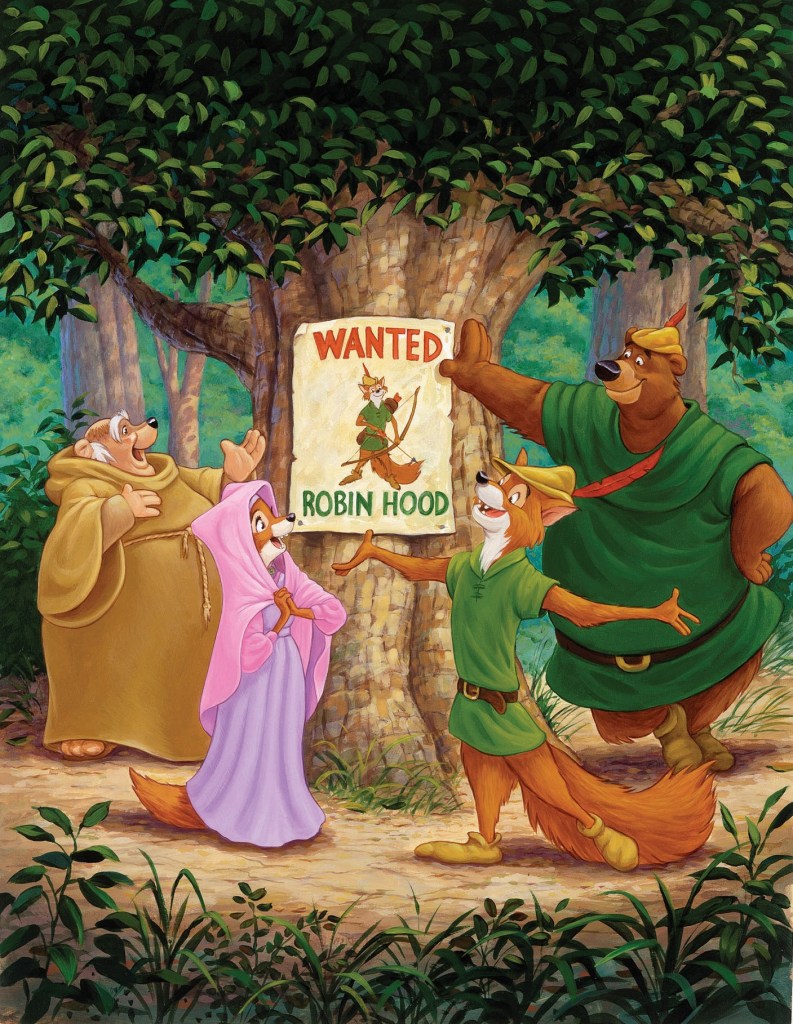
Ken Anderson would be the man responsible for developing the animal designs of the characters. Taking inspiration from the previous attempts to develop Reynard and Chanticleer, he found a way to either repurpose the characters or develop new ones to fit within the setting of the story. His greatest contribution was choosing a red fox as Robin Hood. It was only fitting that the sly, cunning character of Robin Hood would be a fox, as foxes in many fables, including the tale of Reynard, were naturally sly and cunning by nature. By that same logic, it also made sense that Maid Marian would be a vixen to compliment Robin Hood. From there, the pieces fell into place for other animal choices, such as a huge bear to represent Little John’s size, Friar Tuck being a badger (although a pig was also considered at one time but was changed to not offend the Catholic Church), King Richard the Lion Hearted being a large, regal lion, and the cowardly Prince John also being a lion, but was drawn to look scrawny and act like a child with his temper tantrums and outbursts. A wolf representing the Sheriff of Nottingham was ultimately decided on, but originally Anderson wanted a goat in the role to try and break the traditional animal villain stereotype, but was overruled by Reiterman’s seniority. And a snake, who originally was going to be a member of the townspeople, would become head advisor to Prince John in the form of Sir Hiss.
As for Robin’s Merry Men, they were heavily cut in favor of the focus being on Robin Hood and Little John, as Reiterman took direct inspiration from buddy pictures such as Butch Cassity and The Sundance Kid (1969).
In a funny, cosmic sort of way, Walt Disney finally got the heroic version of Reynard that he always wanted without the more unlawful, amoral, crude elements of the character. Disney’s Robin Hood would have the romantic, roguish charm of Reynard, but was a more heroic figure that people could relate to better, mainly because of the premise. In most common versions of the Robin Hood story, the main character was a noble (or a man fighting in the Crusades who returns to his estate now seized by the Sherriff of Nottingham under the orders of Prince John) who could no longer stand by while an oppressive monarch abused his power over the people he was supposed to protect. Thus leading to Robin Hood becoming a theft, but for a higher cause. He was not stealing wealth for personal gain, but to help the people who were being taxed out of house and home as they waited for their true king, Richard The Lion-Hearted, to return to set things right. This was a perfect compromise and is why the story of Robin Hood still resonates very strongly with people today. And was the direction that The Walt Disney Company needed to go in to make this movie work.
And in certain respects, the story of Robin Hood does have a pulp feel to it, as it was and still is a very popular story with a larger-than-life character who is a master archer and swordsman who effortlessly fends off Prince John’s guards, the Sherriff, saving his beloved Maid Marian, helping those in need, going on various adventures and winning the hearts and minds of the people of Nottingham with his debonair charm and personality. This character would influence various other pulp characters such as Zorro, The Lone Ranger, and more modern-day heroes such as DC Comics Green Arrow.
All of these decisions gave the final film something that had not been done before: a chance to tell the tale of Robin Hood with an all-animal cast. Since there had never been an adaptation of Robin Hood, animated or live action, to feature a full cast of anthropomorphic animal characters in the main roles, this was the perfect opportunity to leave a unique impression on audiences and capitalize on the fact that they were the first animation studio to do it. The Walt Disney Company would have quite the feather in their cap, and in turn, would hopefully reward them with a good box office return.
On November 8th 1973, Robin Hood premiered in theaters.
This animated Disney movie in particular is a very personal one for me. It is very near and dear to my heart. It was the very first Walt Disney movie that I ever saw as a child and began my lifelong love of Walt Disney’s animation and animation as a whole. I love this story, its characters, its world and its charming personality.
So, to honor the 50th Anniversary of this unique Walt Disney gem from the Dark Age of Disney, I present to you my review of Robin Hood from 1973.
We begin our tale in the classic style of Walt Disney’s other openings with a big, olive-green book embroidered with beautifully ornate floral patterns and the title of Robin Hood in bold orange, old English font, opening to show the beginning text. There we are introduced to Alan-a-Dale (voiced by legendary singer-songwriter Roger Miller), a wandering rooster mistrial who acts as the narrator of our tale. In a cleaver wink to the audience, he says that while there are many various tales and legends of Robin Hood, those in the animal kingdom have their own version of the story to tell. He then breaks into a whistle and a hum, the opening texts introducing the players of our story.
We are then introduced via the song “Oo-De-Lally” to Robin Hood and Little John, walking through the forest. They are then spotted by the notorious Sheriff of Nottingham, who then pursues our heroes with his own troops. They are of course out-foxed by the pair and escape up a tree, trying to figure out their next move. Little John is worried, but Robin Hood with great confidence and his suave charm tells him not to.
Robin Hood (voiced by actor Brian Bedford) brings the character to life with such heart, humor, charm, confidence, personality and a suave debonair that you can see after all these years why audiences still love this version of the character so much. His confidence and selflessness to help the people of Nottingham and reunite with his true love Maid Marian is just inspiring. And his humor feels genuine and kind. As a classically trained Shakespearian actor, his vocal range was exactly what was needed for the role, which ultimately won him the position over original choices Tommy Steele and Bernard Fox, as Bedford’s voice sounded more heroic for the character.
Little John (voiced by Phil Harris) is also fun to watch and listen to as he effortlessly thwarts off soldiers and can go toe-to-toe with the larger opponents. While a little more cautious, he does have a fun and funny personality to him and knows when to laugh and poke fun at his friend Robin. He gives a fantastic voice performance overall. You feel that he’s known Robin for his whole life and can believe that they are the best of friends, even when he does not always agree with his plans initially. And ironically Phil Harris went from voicing one bear character of Baloo to Little John in only a few short years.
We then see Prince John’s royal coach coming down the road as he travels to the town of Nottingham. He sifts through his bag of gold coins, thanking Sir Hiss for hypnotizing, oops, I mean “convincing” his brother King Richard to go off fighting in the crusades. Because of this, Prince John is appointed as acting ruler until his return. But unlike his kindly, noble brother, Prince John is a spoiled, rotten little brother who desires only two things in life: money and power. So much so that he is willing to tax the people of Nottingham into oblivion to get it.
I just have to say that I love how much actor Peter Ustinov hams it up as the voice of Prince John. One moment he is gleefully delightful in his own cruelty toward others, to then having him lament over his own mother and her loving his older brother more than him which causes him to suck his thumb like an infant, to then having him rant and rave like a madman over Robin Hood alluding his grasp. It’s a true testament to his vocal range as a classically trained actor. He also starred as Captain Blackbeard in the Disney production of Blackbeard’s Ghost (1968). From my research, it was that film that interested the production team to work with him again.
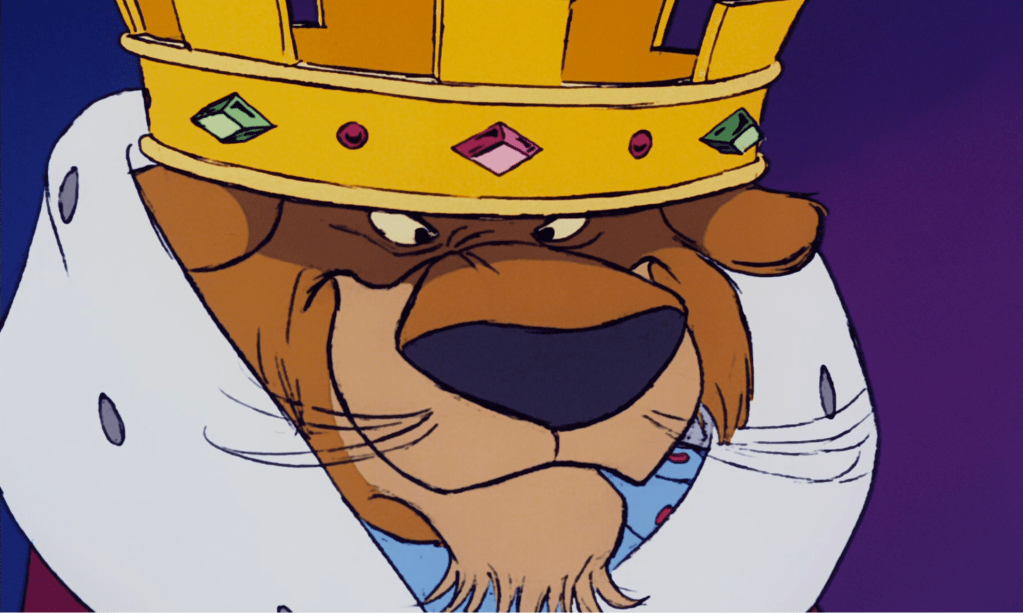
Knowing Prince John’s terrible reputation for unjustly taxing people out of house and home, Robin Hood and Little John decide to help themselves to his ill-gotten gains and return the money back to the townspeople. This leads to one of several times that the pair disguise themselves to maneuver their way through dangerous situations. Just seeing Robin Hood and Little John in this case disguising themselves as lady fortune tellers and hoodwinking Prince John out of his wealth is a true delight, making me laugh and smile each time.
The story then shifts to the town of Nottingham itself, with Alan-a-Dale spotlighting various townspeople who are struggling to survive under Prince John’s rule. The local priest Friar Tuck (voiced by Andy Devine) tries to help the various people by giving them the money needed to pay for their taxes in secret, thanks to the efforts of Robin Hood. It’s here that we are properly introduced to the Sheriff of Nottingham himself (voiced by veteran actor Pat Buttram of Green Acres fame). He, like Prince John, also delights in taking money from the people of Nottingham and acting smug about it. Buttram does an excellent job in such a role, really playing it up with his Southern drawl and acting like a big shot. Much like Peter Ustinov, he was perfectly cast for a role like this.
The Sheriff is so heartless when it comes to collecting taxes that he even takes a birthday present from Skippy, a little rabbit boy who is turning 7-years-old at his very own birthday party. Ouch! If you hated him earlier for chasing Robin Hood, it’s only going to get worse from here. But luckily, Robin Hood later arrives to gift Skippy something special: a bow, an arrow, and a hat of his own.
This in turn leads Skippy and his friends on a misadventure through the castle courtyard where we meet the lovely Maid Marian (voiced by Monica Evans) and we later learn more about her relationship with Robin Hood. While a short scene, we get the feeling that she does have strong feelings for him, even though she is unsure if he even remembers her after so many years apart.
As Robin Hood daydreams about her, accidently burning lunch in the process, Friar Tuck shares news that Prince John is holding a tournament to find the greatest archer. The prize: a solid gold arrow and a kiss from the lovely Maid Marian to the winner. Seeing Robin’s eyes light up like a Christmas tree when he hears this news always puts a smile on my face and his excitement is so catchy. This of course is a trap pointed out by Little John, but in one of the best lines of the film, Robin Hood then says to his friend “Faint hearts never won fair lady.”
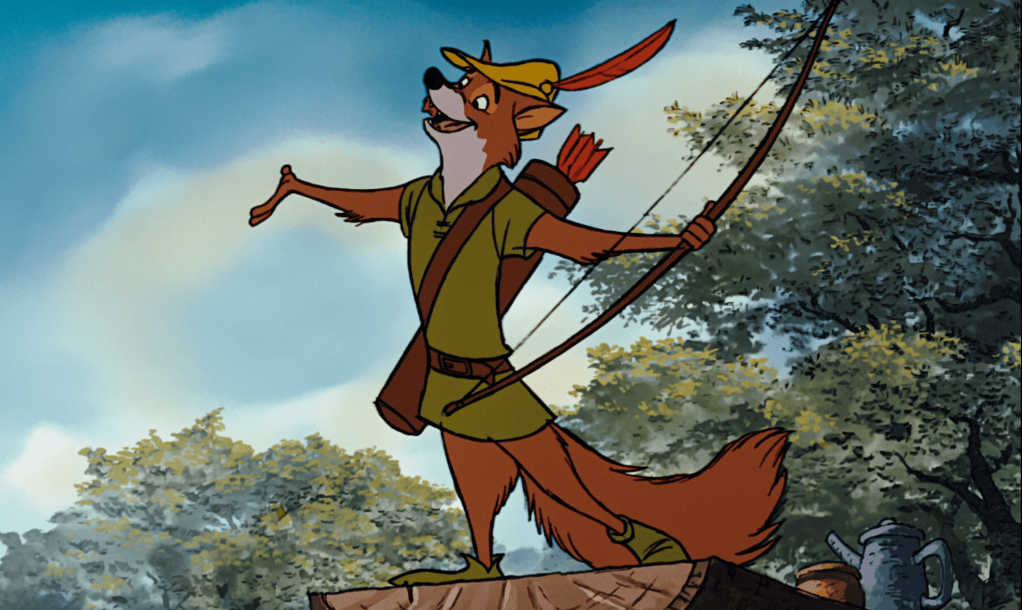
From there we see the tournament unfold, both Robin Hood and Little John disguised as a stork contestant and a royal duke respectively to infiltrate Prince John’s tournament. Sir Hiss (voiced by Terry-Thomas) is commanded by Prince John to look for Robin Hood. He then tries to deduce the identity of Robin while being chased through the fairgrounds by Friar Tuck and Alan-a-Dale. And I have to say, a tip of my hat to the animators for adding his distinguishing gapped tooth into his character design. It always makes me smile to see details like that be added to help add to the actor’s personality and performance in animated features such as this.
After an impressive feat of archery, we later see Robin exposed by Prince John, captured, chained, and ordered by the tyrant to immediate death. Maid Marian is shocked by this decree. With tears in her eyes, she pleads desperately to Prince John to spare his life. In the most cold, sadistically cruel expression, he then says “My dear emotional lady why should I?” She then professes her love for Robin. Looking rather shocked, Prince John then asks Robin if he returns that same affection.
Every time I hear Robin Hood proclaim his love for Maid Marian, with the violin work perfectly capturing the emotion of that scene, I tear up a little. I feel their love for one another is true. It’s genuine and I know that when he says that he loves her more than life itself, he means it. I believe that Robin could never live without his beloved Marian.
After Little John “convinces” Prince John to spare Robin Hood’s life, an all-out brawl takes place. Robin and John fight off John’s men in a very fun back-and-forth battle, with various antics along the way. As hectic and quick as it gets, it’s still a very fun sequence of events even after all these years. After the battle, we then see Robin and Marian return to his hideout, set to the beautiful tune of “Love” by Nancy Adams. This song would later be nominated for an Academy Award for Best Song in a Motion Picture. That’s how excellent it is.
On a personal side note, that very same song would later be used decades later in The Fantastic Mr. Fox in such a beautiful tribute. I still vividly remember being in the theater, listening to the music in the background and was thinking “Hey, I think I’ve heard that song before. Where is it from? Oh my God, it’s Love from Robin Hood!” That’s when I knew that Wes Anderson truly understood the power of film and adding little details like that helped to elevate his work to a higher plane. He clearly knew his audience and how they would make the connection to Robin Hood, as both main characters are foxes. Now back to the review.
The foxy couple are then surprised by Friar Tuck, Little John and the various townspeople with a party in celebration of their love, Robin’s recent triumph and a rallying cry to take down the notorious Prince John with one of the best jazzy songs of the whole movie “The Phony King of England.” Some have noticed over the years that this song strongly resembles the old English pub ballad “The Bastard King of England.” If true, and for obvious reasons, the lyrics of this song would be changed heavily to keep it more family-friendly while being a funnier take on Prince John acting as a childish ruler.
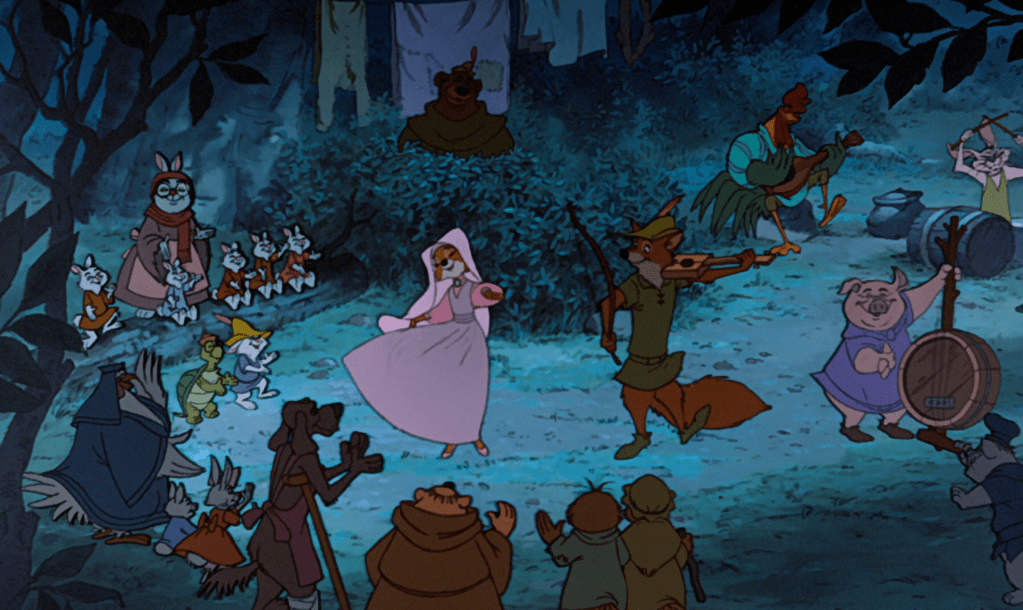
And for those eagle-eyed viewers of these kinds of animated Disney features, there are multiple reused animation scenes that are copied from previous Walt Disney films. From Maid Marian being brought to dance (directly referenced from Snow White and The Seven Dwarfs) to Little John dancing just like Baloo from The Jungle Book (very ironic because Phil Harris also voiced Baloo as well) to the band playing that was also copied from The Aristocats, some would say that it was lazy. However, there was a legitimate reason for this, as this was a technique used to save time. The original production of the film fell behind schedule due to finding its voice cast and several scenes needing more time to draw out. Because of this and a tight deadline, the dance number had to reuse animation.
Word of the song eventually reaches Prince John, who is beyond furious at the idea of him being mocked in such a fashion. He retaliates with heavier taxes and jailing those who cannot pay them. This leads to many of the townspeople going to jail, forced to work off their debts. This in turn escalates to Friar Tuck being jailed as well for standing up to the Sheriff, with Robin Hood and Little John going to rescue him before he is hanged, saving the townspeople, and taking back the money Prince John unjustly took from everyone else in the climatic 3rd Act.
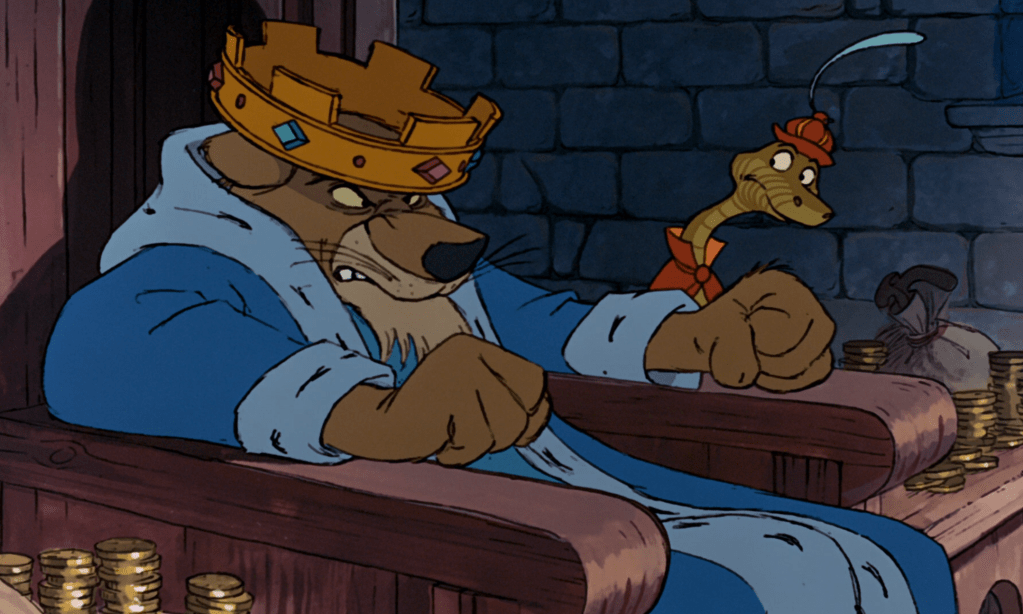
One scene that stills sticks in my mind long after rewatching this classic was the events after Friar Tuck’s imprisonment. As a storm pours down outside, we pan into the castle tower to see Prince John, slumped down in his chair in front of a fireplace, his face scowling, loathing, silent, miserable. He is surrounded by all the gold that he has taken from the people of Nottingham. Sir Hiss notices his misery and asks why he has not counted his money, as it usually makes him happy. Then in a desperate attempt to cheer him up, he tells Prince John that taxes are pouring in, those who cannot pay them are being jailed and the recent news that Friar Tuck has now been imprisoned. But none of that matters to him. In a great outburst, showering coins left and right as he throws his arms in the air, Prince John declares that it’s Robin Hood that he wants. Even going as far saying that he would give up all of his gold if it gives him the outlaw. That scene in particular showcases that even with all the wealth he accumulated, even with everything going his way, he would never be truly happy. Thus showing a very human flaw in his character that we can see in ourselves if we lose sight of the things that are far more important in life.
Now for some fun facts before I wrap up this review:
Fun Fact 1: The xerography process that was first used in 101 Dalmatians (1961) is used in full force in this movie. This process was originally used to help save money and time for multiple Disney animated features. This helped to save The Walt Disney Company after the initial poor box office numbers for Walt Disney’s Sleeping Beauty (1959). Sleeping Beauty was also the last cel animated feature that was inked by hand for the company.
Fun Fact 2: Prince John’s crown constantly slips down his head throughout the movie, even with his ears folding outward. This was a nice visual jab at our main villain, as it clearly shows that he is not fit to wear the crown of his more noble older brother.
Fun Fact 3: Speaking of crowns, a scene in the Disney animated series Zootopia+ shows the character of Duke Weaselton does a song and dance number that showcases the pros and cons of his “Get Rich Quick” schemes. At one point during the song, he wears Prince John’s crown.
Fun Fact 4: A very unique detail that’s not always talked about is how Maid Marian wears a silk scarf over her fox ears. When she does this, it resembles a classic Horned Headdress. A beautiful detail that not many people would pick up at first.
Fun Fact 5: Of course, like many Disney adaptations, this film takes several major liberties from the original story. One of the bigger ones is that in this story, Richard and John are brothers, whereas in the original tale Prince John is King Richard’s cousin.
Fun Fact 6: One unique impression that Robin Hood would leave on early Internet culture was in 1998, when Canadian art student Deidre LaCarte used the song “Whistle-Stop” from the film at a sped up pace combined with GIF’s of various hamsters and rodents to dance to the tune. This would be known as the “Hamster Dance” and is cited as one of the earliest Internet memes.
Fun Fact 7: Roger Miller would write and perform 3 songs in the movie. They were “Whistle Stop,” “Oo-De-Lally,” and “Not in Nottingham.”
Fun Fact 8: In addition to Robin Hood being the first full length animated feature film adaptation of the original story with a full anthropomorphic animal cast, this was also Disney’s first animated feature film to have no human characters in it whatsoever.
Fun Fact 9: There was an alternate ending to this film that would have had Prince John tail Robin Hood back to the church, still recovering from his wounds. Looking more like an assassin instead of a king, Prince John would have attempted to end Robin’s life with a dagger, but is stopped by King Richard himself. This idea got as far as the storyboarding, but was ultimately changed. More than likely to give Robin Hood a more triumphant ending and to carry on the Walt Disney tradition of showing good overcoming evil.
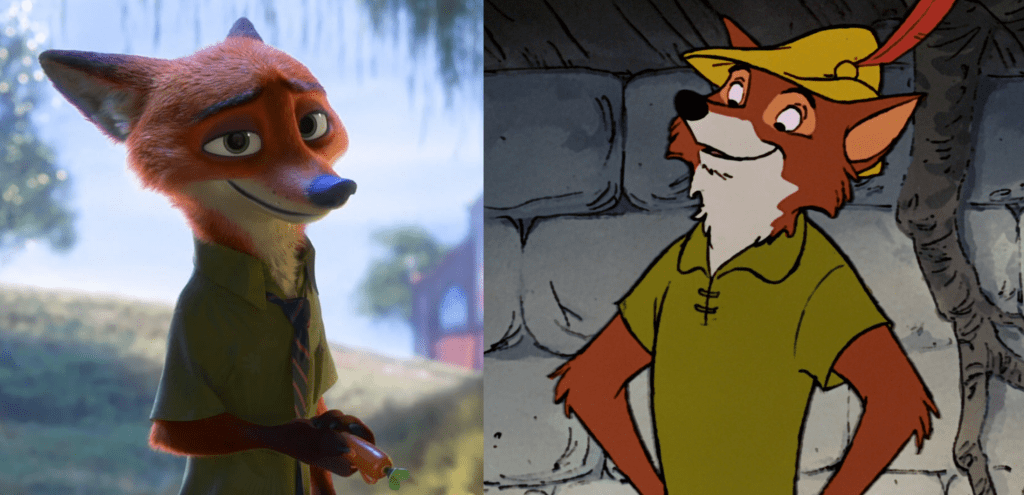
In the end, the film succeeded in a solid box office return, exactly that the Walt Disney Company needed at the time. And with its second re-release in theaters in 1982, it did even better in returns. Robin Hood would leave a lasting legacy that still inspires creators even to this day. One major example of this would be the 2016 Disney film Zootopia, which took heavy inspiration from Robin Hood according to its director Byron Howard. From one of the main characters, Nick Wilde, being a sly, witty red fox (a major homage to Robin Hood himself and one that fans of both films theorize that he is a direct descendant of Robin Hood) to the use of size difference between different animal species to show off their unique physical features, abilities, attributes, talents and how they would live in a real-world setting that parallels our world, the original 1973 classic still leaves a major impression. Howard even cited that he got into the field of animation because of Robin Hood, and was his favorite film growing up.
At the end of the day, it’s your classic story of a hero who is needed in dark, desperate times. He rises to meet these challenges, rescues his lady love, and helps those in need selflessly as he and his friends work together to push back against an oppressive power-hungry monarch who believes that the people should serve him above all else without giving back anything in return. It may not be groundbreaking in it’s story, but it does not need to be. It’s a classic for a reason. Especially with a collection of ideas and changes that just happened to come together in just the right way. The film itself does a great job of balancing the main story while adding in the right amount of musical numbers that help to flesh out the right emotional moments of the story. It never goes “full on musical” with its number of musical set pieces like earlier or later Disney films would go (minus the “Phony King of England” number), but in this more narrative driven story, it did not need to. It also leans more into the humorous aspects of the main characters disguising themselves, making fun of Prince John’s childish nature, the physical comedic aspects of characters like John’s crown slipping down his head and Robin Hood tricking Prince John. And to its credit when a moment is serious, such as Friar Tuck forcing the Sheriff out of his church and fighting him outside, it’s played straight. You really feel the weight of the scene when they do it right. While it may not be the greatest animated Disney film of all time in the House of Mouse’s vast catalog, it’s still a beloved classic that needs to be seen by any fan of classic, hand-drawn animation. It’s a fun tale that shows the importance of heroism in the face of adversity, especially in these trying, unprecedented times. It reminds us to keep our chin up and to keep hope alive, as things will get better and happiness will return. The wit, charm and sincerity of Robin Hood himself as he offers hope to the downtrodden townspeople of Nottingham, standing up to bullies like Prince John and the Sheriff at every turn, opening his heart up to the woman he loves and his commitment to helping his friends when they need it most is very inspiring and something that we can all learn from. Robin Hood is a beautiful, self-contained story that embodies the heart of the original tale of Robin Hood while adding that “Disney Magic” that Walt himself would have loved to see if he were still alive. Walt Disney may be gone, but his message of hope, joy, and optimism still lives on in this film.
And for more updates on pulp films, movie news, celebrating milestones, upcoming physical releases of classic films and fun posts, check out The Pulp Movie Palace on X (Twitter), Facebook, Instagram and YouTube!
 Pulp Movie Palace
Leave a comment