Film noirs have always been a staple of the American cinematic experience since the 1930’s. By the 1940’s and 50’s they came into their own; dominating the silver screen and becoming the genre that we know and love today. Tales of tough detectives tracking down dangerous criminals with a dame in hand and a revolver in the other, what more could you ask for?
But what if you combine the film noir experience with the literary world of H.P. Lovecraft?
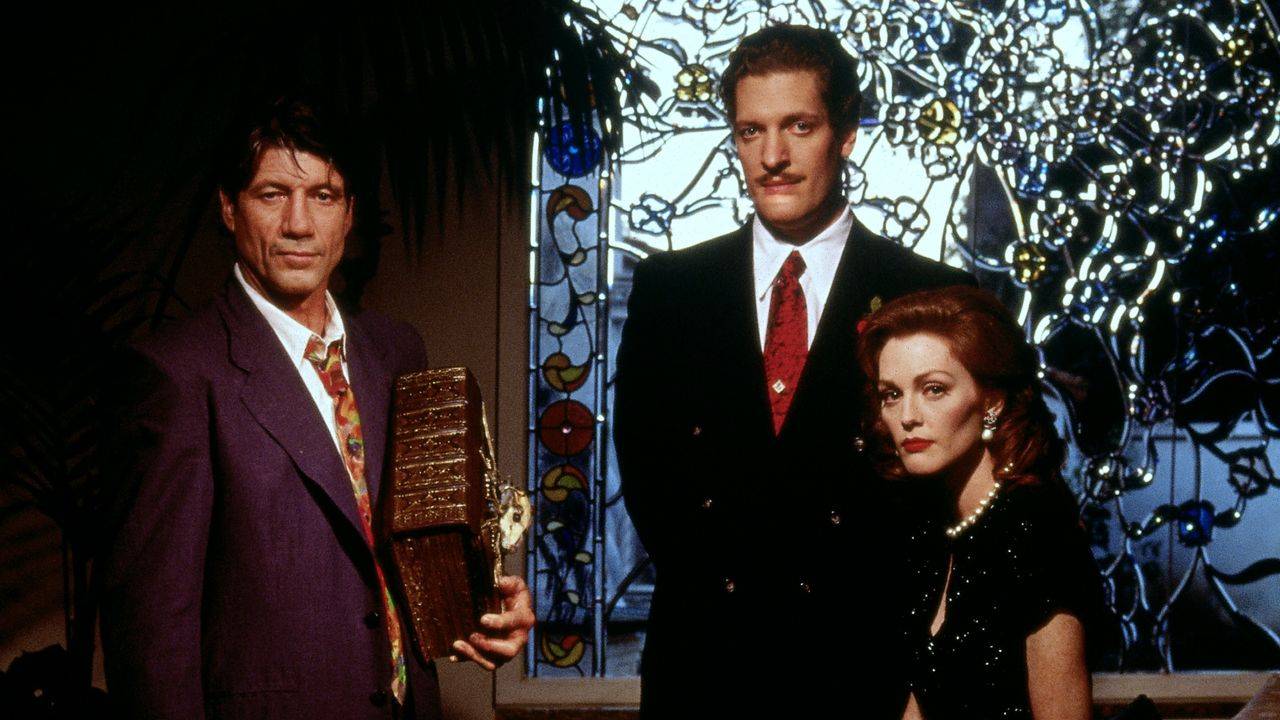
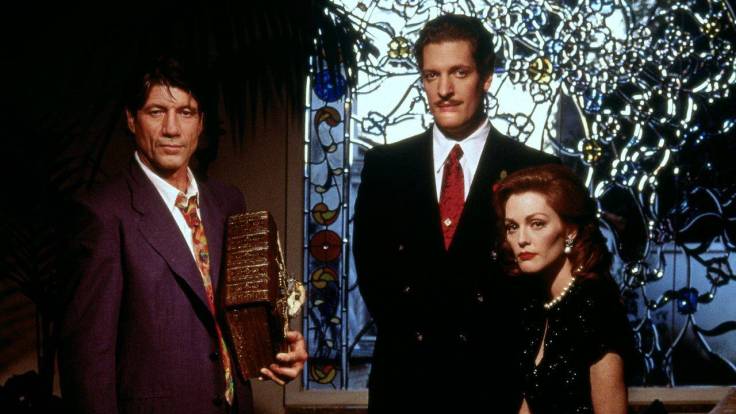
You get the 1991 cult classic film Cast a Deadly Spell. A unique blend of hard-boiled detective story with the dark world building of eldritch horror.
Originally made by HBO Pictures back in the early days of the HBO cable television channel service that was looking for new original programming to air, this made for television film has mostly gone unheard of unless you actively track it down.
While information on this movie is scarce, my gumshoe instincts are telling me that with the revival of the pulp adventure and noir genres in the 1970s, 80’s and 90s by George Lucas (Star Wars & Indiana Jones), Steven Spielberg (E.T. & Indiana Jones) and Robert Zemeckis (Tales From The Crypt & Who Framed Roger Rabbit), someone at HBO more than likely wanted to capitalize on that while the iron was hot. With pulp film revivals like The Shadow and The Phantom coming out, along with other original pulp inspired adventures such as Raiders of The Lost Ark and The Rocketeer making waves, I bet my bottom dollar that they wanted “A Piece of The Action.”
But don’t let the “Made of TV” label fool you. This film is no slouch when it comes to using its budget wisely and making every scene count with its gripping story, well-developed characters, stellar cast, musical score, cinematography, and practical effects that have aged like a fine bourbon. So let me tell you the tale of Cast a Deadly Spell.
Set in an alternate Los Angeles in 1948 where magic is commonplace and most people use it in their daily lives, a nervous man named Mickey delivers a rather large grimoire to Harry Bordon, the head mob boss who runs the Dunwich Club. After discovering that the book is a fake, he orders his top lieutenant Tugwell to get the book back. Tugwell then offs Mickey using a spell that gives new meaning to the term “Death by a Thousand Cuts” in one of the most creative ways I have seen a mob lieutenant take out a guy. The real grimoire meanwhile is then picked up by Mickey’s main squeeze Lilly Sirwar at a train station, who spirits it away to parts unknown.
We then cut to a sting operation in progress, with police detective Bradbury confronting detective Otto Grimaldi on what’s going on involving a voodoo doll. Enter Harry Philip Lovecraft (played by Fred Ward of Tremors fame), former officer turned private investigator and a man who refuses to use magic in his detective work. He helps pick up the pieces of the case and then walks away, with Grimaldi insulting Lovecraft on his lack of fashionable ties.
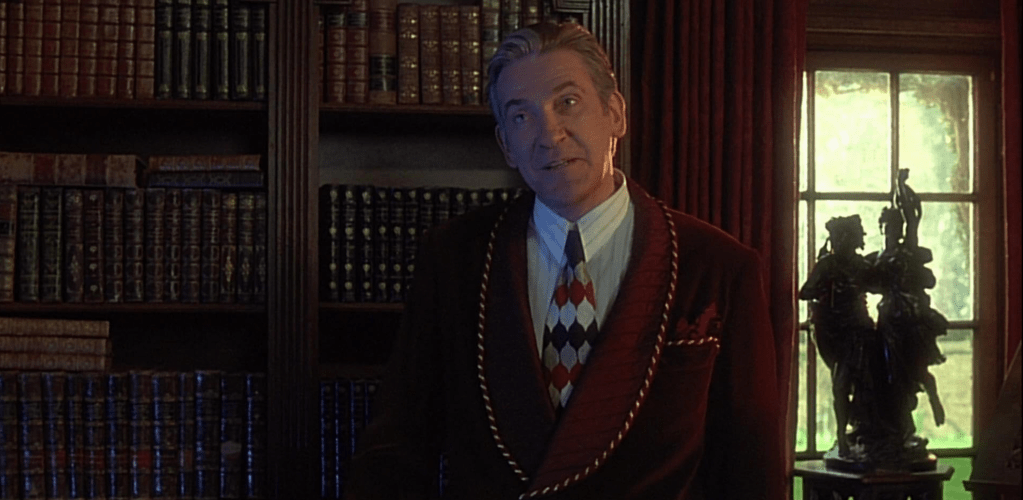
Lovecraft is then hired by a mysterious millionaire named Amos Hackshaw (played by the late great David Warner) to find the Necronomicon, a powerful spell book, and return it to him before a specific date at 12 midnight. He also runs into Hackshaw’s daughter, Olivia (played by Alexandra Powers) who becomes fascinated by Lovecraft, as she is cooped up in the stately manor where Amos protects her purity from the outside world.
From there we follow Lovecraft through a series of events of intrigue, suspense, and action as he learns the deadly truth of what the Necronomicon can actually do and the horrors that await if used for the worst of intentions.
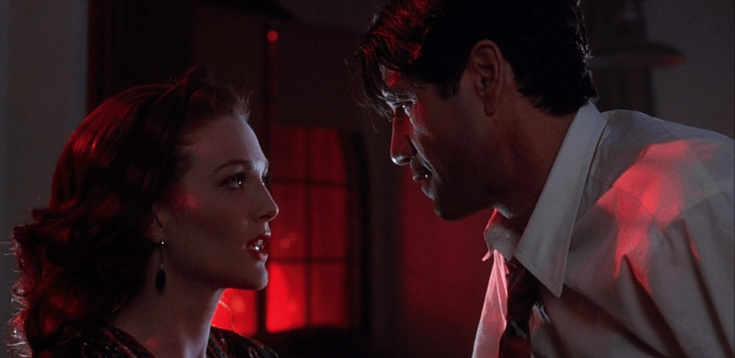
The actors all give fantastic performances all round. One character that I quickly fell in love with was Julianne Moore’s Connie Stone, a smokin’ hot bombshell who sings at the Dunwich Club. Her sorted past with Lovecraft is genuinely interesting, and you wish that they can find a way to reconcile their relationship.
One of my favorite scenes was Lovecraft and Stone sharing a conversation in Lovecraft’s office, where he explains why he doesn’t use magic. It’s a powerful scene that just speaks for itself and showcases why Fred Ward was the right choice to play the character of Lovecraft. His reasoning for not using magic is a moral one, one of integrity and a promise he made to himself as a man. Lovecraft does not desire to make any pacts with demons, devils, the supernatural or any two-bit hustler who wants to stick it to him. He may never achieve the high success of others who compromise their integrity by using magic, but in his own words “Nobody owns a mortgage on my soul. I own it, free and clear.”
The dynamic between Fred Ward and Clancy Brown’s Harry Bordon just crackles and pops. Once brothers in arms of the law now rivals, you can feel the tension between them as the game of cat and mouse intensifies throughout the film.
And of course, I cannot forget to mention the excellence of David Warner’s portrayal of Amos Hackshaw, a man hellbent to risk it all to summon the “Great Old Ones” and become a god, no matter the cost. The third act of seeing him reading the Necronomicon is worth the watch alone. But in the end, as in all deals with forces beyond our comprehension, be careful what you wish for, because there’s always a price to be paid.
The subtle and unique details of a world where magic is used daily in a 1940’s setting is very fascinating. From zombies shipped from the West Indies being used as muscle and working labor to using magic to carry suitcases, light cigarettes, mix drinks or causing a prank on a neighbor’s car by a group of kids, the world building of Cast a Deadly Spell fits the time period very well.
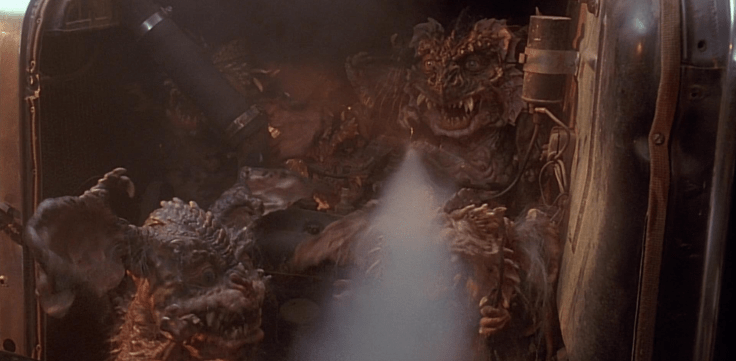
One of my personal favorite details was when Lovecraft visits a flophouse in search for the Necronomicon and the whereabouts of one Larry Willis, Amos’s chauffeur who originally stole the book from him. The owner, as he converses with Lovecraft, then discovers gremlins emerging from an overheated car engine that he was working on. This was an excellent reference to the stories that World War II pilots and mechanics would talk about when explaining how some of their planes would mysteriously stop in mid-flight or how an engine would malfunction before takeoff, believing that they were caused by these mischievous creatures. Something that I personally learned from my talks with my uncle, John Leiger when he was still alive, as he loved World War II history. These kinds of stories would become further cemented in history with the Merry Melodies Bugs Bunny 1943 theatrical short ‘Falling Hare’ and Joe Dante’s Gremlins movies. It’s little details like this that I love in movies and clearly shows that the writer, Joseph Dougherty, did his research when it came to details like this.
And speaking of details, the cinematography for this movie is in perfect step. Director Martin Campbell clearly understood the film noir style as he was filming and it feels very special because of it. The attention to detail alone with 1940’s Los Angeles is also quite the sight, even for a smaller budget like this. It is stunning with the art deco style of the Dunwich Club, to the diner Lovecraft visits with Olivia, to the housing development of Vista Bonita and the ornate interior of the Hotel Ashcroft, the art department did an executional job for the budget that they were given.
Joseph Dougherty’s writing gives Cast a Deadly Spell a unique charm, personality and premise that makes it truly stand out from other “Made-for-TV” movies of the time. Especially given the freedom on a pay-for-cable service that allowed the film to go further with its premise and more mature storytelling and themes, thus earning it an “R” rating.
The use of many practical effects for the gremlins, various demonic creatures and a massive eldritch horror brought a smile to my face and filled me with wonder. The amount of detail for the various creatures and the puppetry that went into them really paid off and felt genuine. From the gremlins scurrying around the flophouse carpet to a summoned demon from a cooking pot ready to tear its victim apart, it’s why I still prefer practical effects over CGI. Not to say that CGI is terrible and should never be used, but when overused and not given the right amount of time to be made, it looks bad and dated.
Curt Sobel’s musical score compliments the time period perfectly. With the song “Why Do I Lie” being the standout hit that captures the feeling of Lovecraft and Stone’s conflict with one another. It feels like true film noir in its lyrics and in the world that it is set. It’s haunting, beautiful and sad all at the same time.
For H.P. Lovecraft fans, the number of references, big and small, from the Dunwich Bar to the Ashcroft Hotel, are numerous. There are plenty of various references to his work peppered throughout the film and within the storyline itself to spot.
You can tell that the cast puts in a genuine effort for such an off-the-wall idea, but they play it straight. The stubborn Lovecraft who still carries a torch for his love Connie, the ruthlessness of mob boss Harry Bordon, the overworked Bradbury dealing with all the craziness on a daily basis, and the excellent performance of David Warner in every scene that he’s in, there is not one bad performance from the cast.
In short: I love this movie. It’s everything that I enjoy in a film noir mixed with fantasy and horror that’s balanced just right. With a fantastic cast, an engaging storyline, excellent use of practical effects, a fantastic presentation of Los Angels, a realistic portrayal of mid 1940’s American culture, and a fitting musical score to tie it all together, this is one film to check out. So if you’re looking for a different kind of film noir with a pulp flavor, look no further than Cast a Deadly Spell.
And for more updates on pulp films, movie news, celebrating milestones, upcoming physical releases of classic films and fun posts, check out The Pulp Movie Palace on X (Twitter), Facebook, Instagram and YouTube!

 Pulp Movie Palace
Leave a comment